

How Winning a Hackathon Reminded Us Why We Design
That gap is where the real work lives.
It requires time, consideration, and a willingness to get lost in the process. It's what draws us to this field and what makes a social impact hackathon feel like the right place to put that to the test.
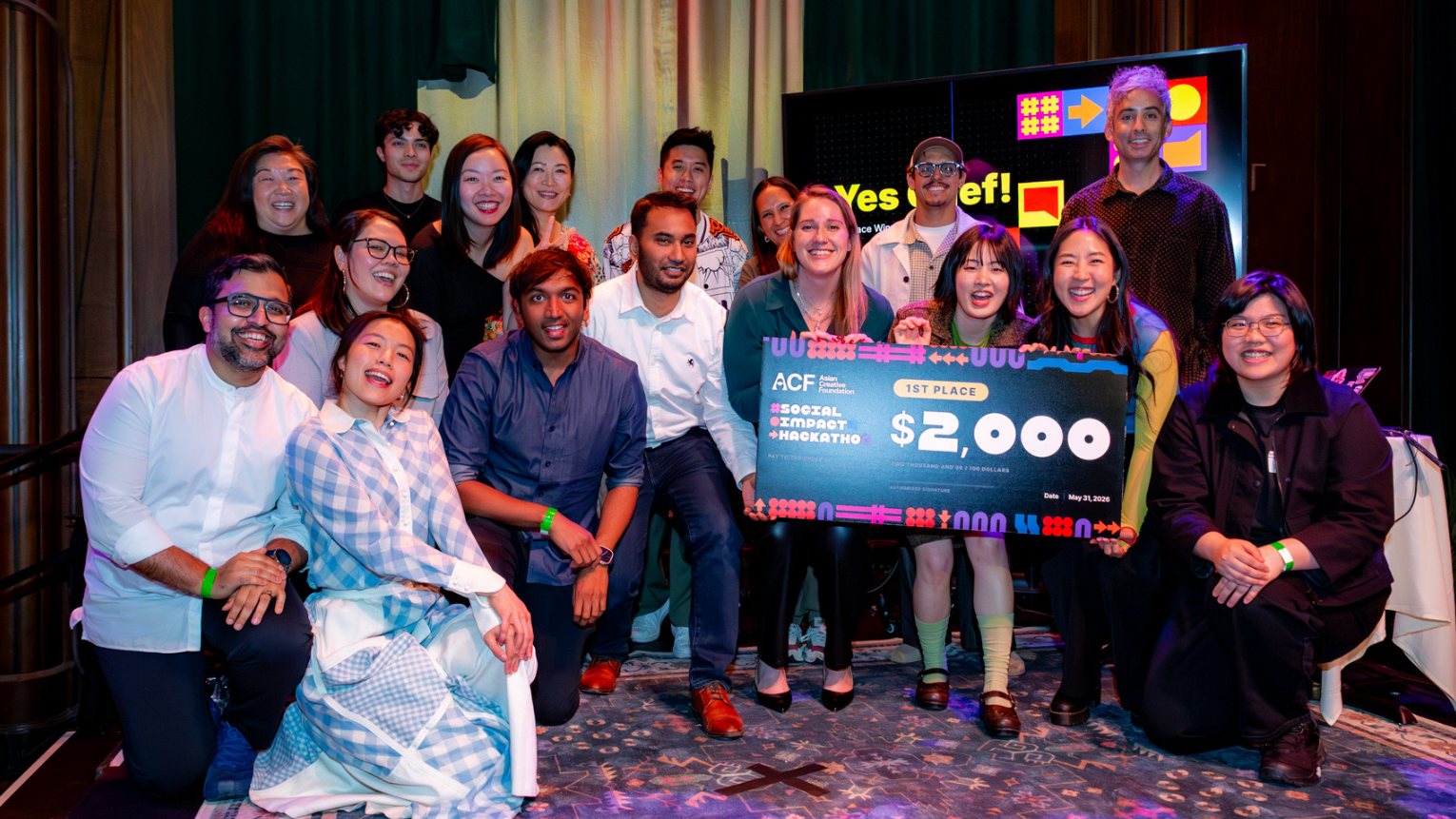
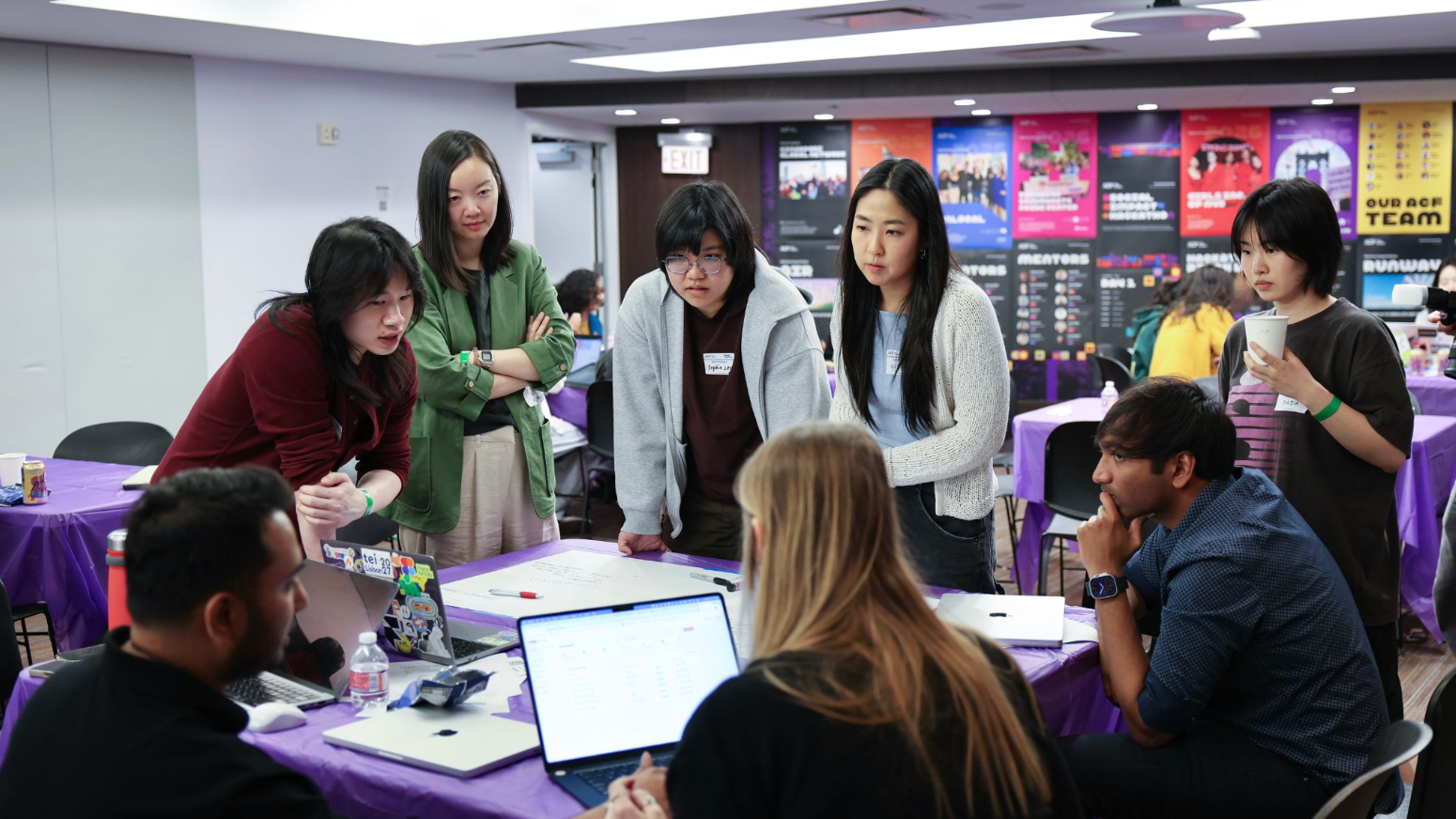
On May 30–31, the Asian Creative Foundation hosted its Social Impact Hackathon at NYU — two days, 12 teams, five nonprofits, and over 60 participants brought together to tackle real challenges facing New York communities. The nonprofits spanned a range of causes: the New York Immigration Coalition, Transportation Alternatives, Girls Inc. NY, Brooklyn Community Pride Center, and UnLocal. Teams of designers, strategists, and creatives worked alongside each organization, pitching their final work to judges at Conwell Hall on the second day.
We competed as a team of six — four SVA Interaction Design MFA students (Sophie Lee, Kathy Choi, JuJu Kim, and Darren Chia) alongside two collaborators (Cassie Henson and Syeed Siddique) — assigned to the New York Immigration Coalition. We took first place. But what's stayed with us since isn't the outcome.
First, We Listened
Before any designing happened, we sat down with a representative from NYIC to understand who they are and what they needed. They walked us through their work, their community, and 40 years of advocacy on behalf of immigrant New Yorkers. It was the kind of conversation that recalibrates you. We came in with ideas. We left with context. And every choice we made after that, we made with them in mind.
Making Space for Stories
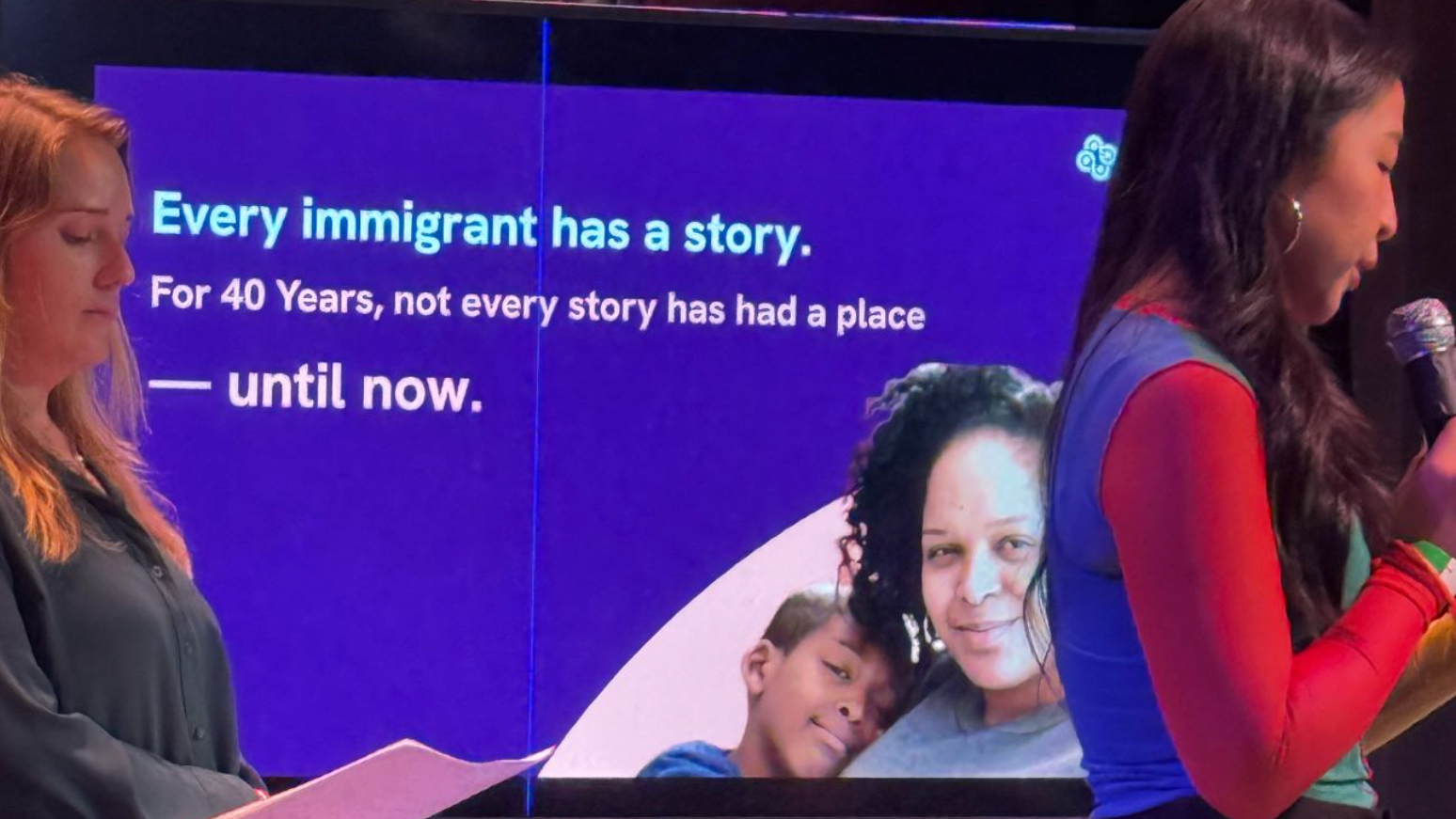
NYIC's stories have moved legislation and shifted public perception. They are among the organization's most powerful advocacy tools. But stories don't organize themselves. They get lost, scattered across emails, documents, and individual memories, never reaching the people or moments where they could create change. That was the problem we were solving.
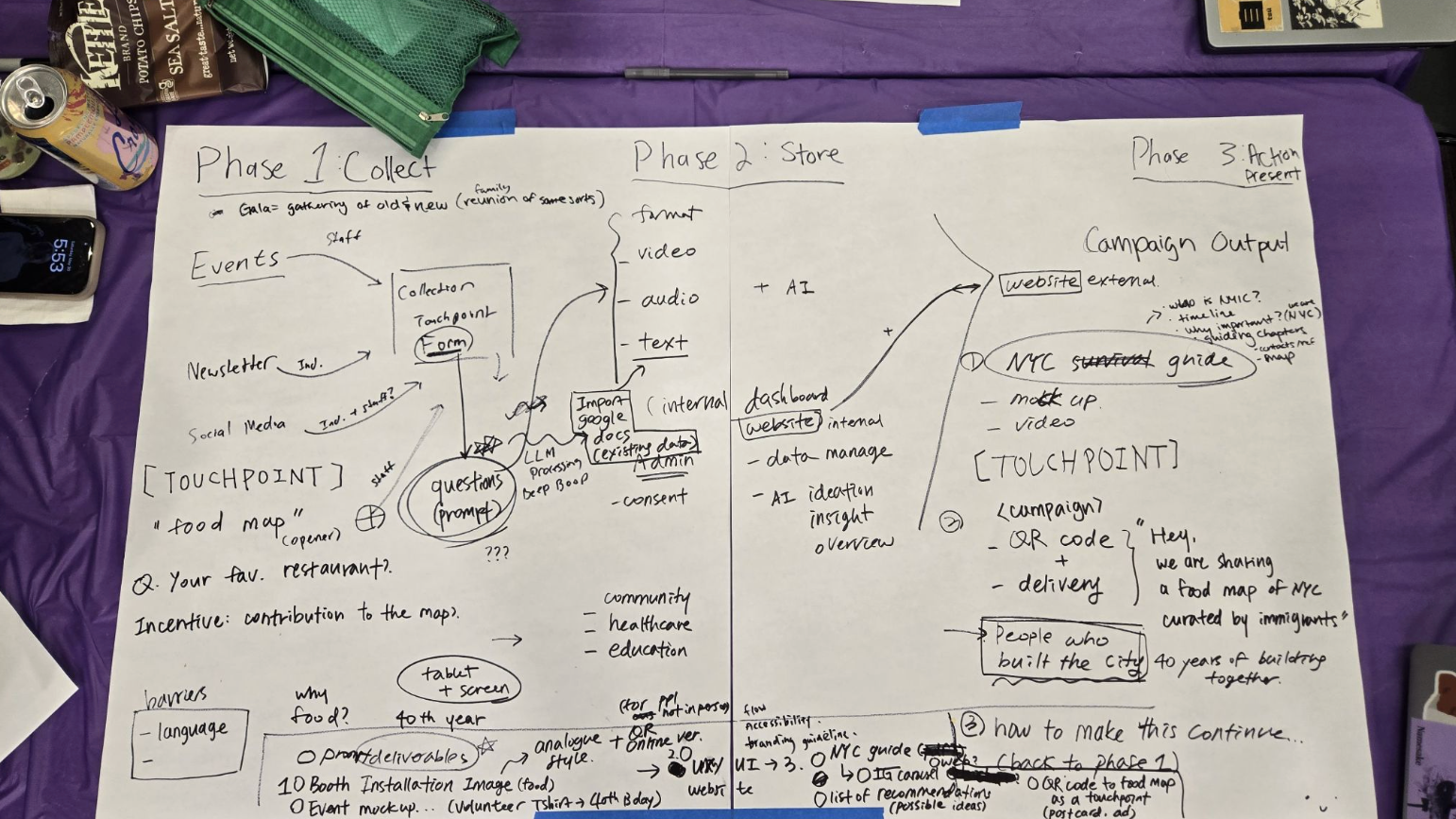
We designed a story banking system: a website where NYIC staff and members can submit, store, and organize immigrant stories in any format and any language, with full control over how each story is used. The infrastructure is only part of it. Stories need a reason to be told. So we built a campaign around the line: 40 Years of Setting the Table for Communities. The premise was simple and true: immigrant New Yorkers didn't just arrive in this city. They helped build it.
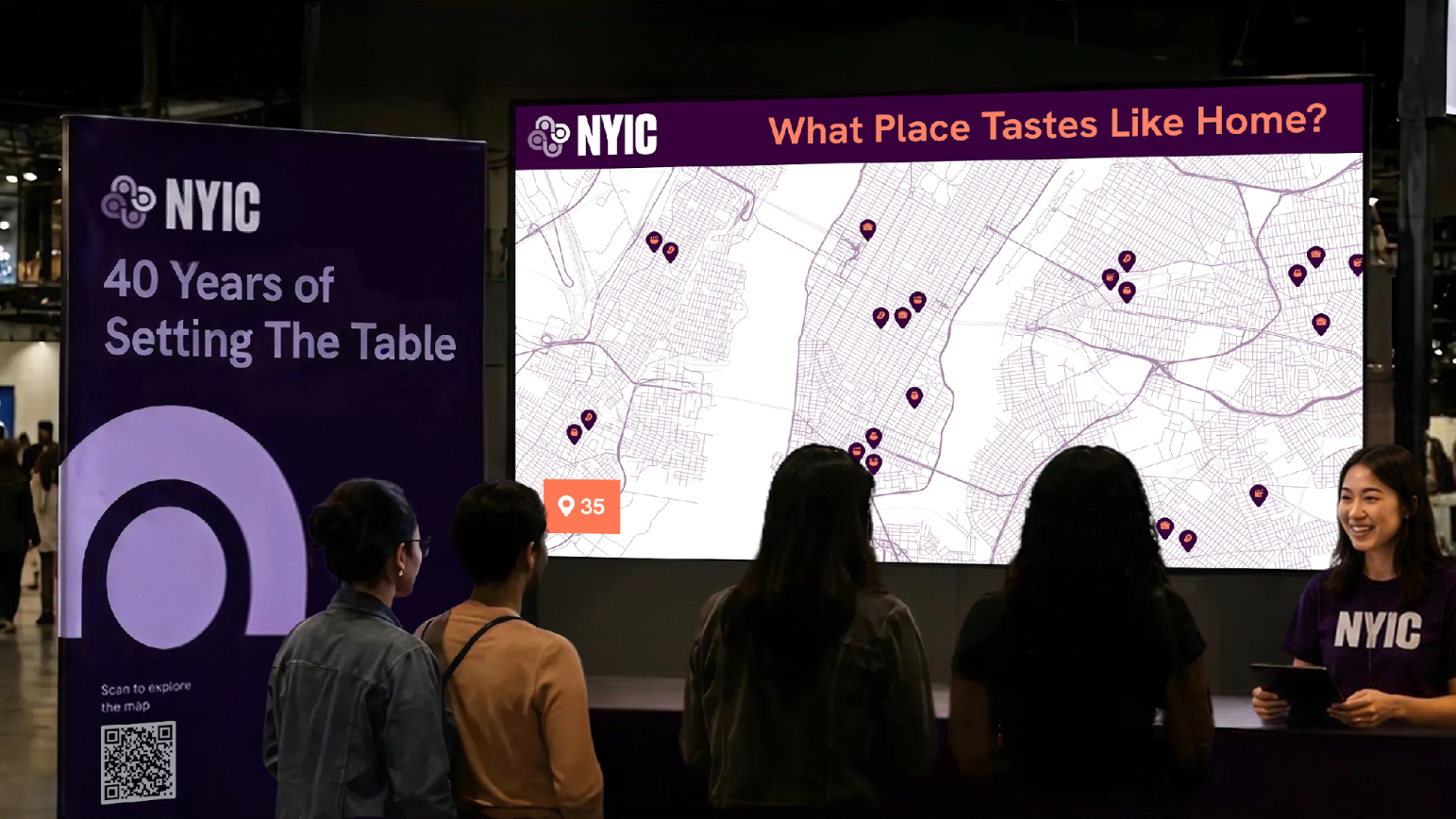
To show how that campaign could come to life, we designed print collateral and an event activation for NYIC's 40th anniversary gala. The activation invited attendees to submit their favorite immigrant-owned restaurants in NYC, which populated a shared community map in real time. We anchored it around the prompt "What place tastes like home?" because food is one of the most immediate ways people connect to memory, identity, and community. A personal way into a much bigger story. It also doesn't hurt that everyone has an opinion about where to eat.
The SVA Foundation
The SVA Interaction Design program had been building toward something like this without us realizing it. A year of frameworks, critiques, and research methods — and then 24 hours to put all of it to use at once. No pressure.
What surprised us was how naturally it kicked in. When we sat down with the NYIC representative, we weren't just listening out of courtesy — we were doing research. Asking questions that opened things up rather than steered. Taking in what was actually being said rather than confirming what we already thought. The program had trained us to do that, and in that room, it happened without us having to think about it.
The same was true for how we approached the problem itself. Rather than latching onto the first solution, we mapped the full journey: how stories get collected, stored, and eventually put to use, rather than zeroing in on one piece of it. That instinct came from our coursework in service design and inclusive design, which pushed us to consider accessibility and impact at every stage.
By the time we stood in front of judges at Conwell Hall on day two, everything came together. Building a narrative, earning trust, letting the work speak. The program had trained us to do all of it.
What the Weekend Taught Us
Competing across five different nonprofits showed us how many ways there are to approach community-centered design. Different problems, different communities, different solutions, but the same underlying spirit. What surfaced was how collective this is at its core. Social impact work is usually slow and deeply relational. A hackathon compresses that into 24 hours. Uncomfortable, clarifying, and occasionally fueled by sheer adrenaline. But having designers, nonprofit staff, and organizers all working toward something that matters in the same room was motivating in a way that's hard to manufacture.
More than anything, this experience reinforced what we want to carry into every project: the work isn't about us. As designers, we're here to serve: to show up fully, listen carefully, and make something worthy of the people who trusted us with their story.
On Designing With Purpose
A hackathon isn't a perfect stand-in for sustained community design work. It's compressed and competitive in ways real partnerships aren't. But it offers something genuinely hard to replicate: accountability to someone outside yourself, in real time.
Design shapes how people perceive the world and what they believe is possible. That power means something when it's in service of a community — when the problem is real, the stakes are human, and the solution has to earn its place. That's the design worth getting lost in.
To ACF, to NYIC, and to SVA's Interaction Design program: thank you. We're proud of the win. The people we met along the way and the collaborative spirit of this event will stay with us long after the weekend itself.
When Space Becomes Interface
 Student Bloggers / Spatial Computing