
What Sitting With Ambiguity Taught Me About Design
At the beginning of the semester, it’s easy to imagine thesis development as a process that moves steadily from ambiguity towards certainty. Many of us start the process expecting a moment when the topic clicks, followed by a more linear sequence of research, analysis, and direction. What this semester revealed, both through my own work and through observing others in the studio, is that the thesis process rarely unfolds in such a straightforward manner.
Declaring a thesis is not a simple decision. It is an evolution that happens gradually over time, as we conduct interviews, struggle to articulate what feels important, and question whether we are moving in the right direction. Rather than signaling a lack of progress, that uncertainty turned out to be central to the work itself.
“There were constant ebbs and flows in my certainty regarding my thesis and my ability to pursue it. What led me to feel assured was being present in the process and understanding that a thesis that is explored with depth is anything but linear.”
— Jeremie Candio, ixD student
Over time, I began to understand thesis development as a practice in staying with ambiguity long enough for meaning to surface. The strongest insights did not emerge when we rushed toward answers, but when we allowed questions to deepen, shift, and sometimes unsettle our initial assumptions.
Early in the semester, much of the energy in the room was focused on naming problems clearly and defending emerging directions. Yet clarity rarely appeared when it was forced. Instead, it emerged through sustained attention and staying present with the work rather than pushing it toward premature resolution.
"I stopped forcing answers to arrive on schedule, because being early can look like being wrong, and I’d rather be true than fast."
— Ying Chung, ixD student
What became clear is that ambiguity is not something that designers should avoid. Rather, it is a space that trains students in careful observation. Sitting with this ambiguity allowed patterns to surface that would have remained invisible and encouraged deeper engagement with context, systems, and the often-unspoken forces that shape behavior.
This shift also revealed something important about design practice more broadly. Many of the problems designers are asked to engage with today—social, ethical, environmental, or systemic—do not offer clean boundaries or straightforward resolutions. Thesis development became a space to practice holding that complexity, including the contradictions that naturally occur within complex issues.
I saw how this process tested more than technical skill. It asked for emotional resilience and patience. Some weeks felt energizing, when a conversation or critique opened up new ways of thinking. Other weeks felt heavy, especially when we were engaging with emotionally charged material or confronting the limits of their current framing. Both states were part of the work.
“I accept that progress sometimes looks like a pile of half-finished things, and I’m willing to keep making and testing, even when the outcome isn’t guaranteed.”
— Ying Chung, ixD student
One of the most noticeable shifts over the semester was in how we learned to listen. Needs were rarely articulated directly in interviews or discussions. Instead, meaning surfaced through contradictions and moments of vulnerability that were created through sustained conversation. As the semester progressed, we became more attuned to what wasn’t being said, reading emotional data alongside verbal responses. This attentiveness proved to be a critical part of the research process.
This sensitivity also extended beyond research settings. Many of us began noticing how small design decisions could set off chains of influence: shaping expectations and affecting others in ways that were not immediately visible. Thesis development encouraged a broader view of responsibility in design, not as something passive, but as something designers actively bring to the surface through thoughtful communication.
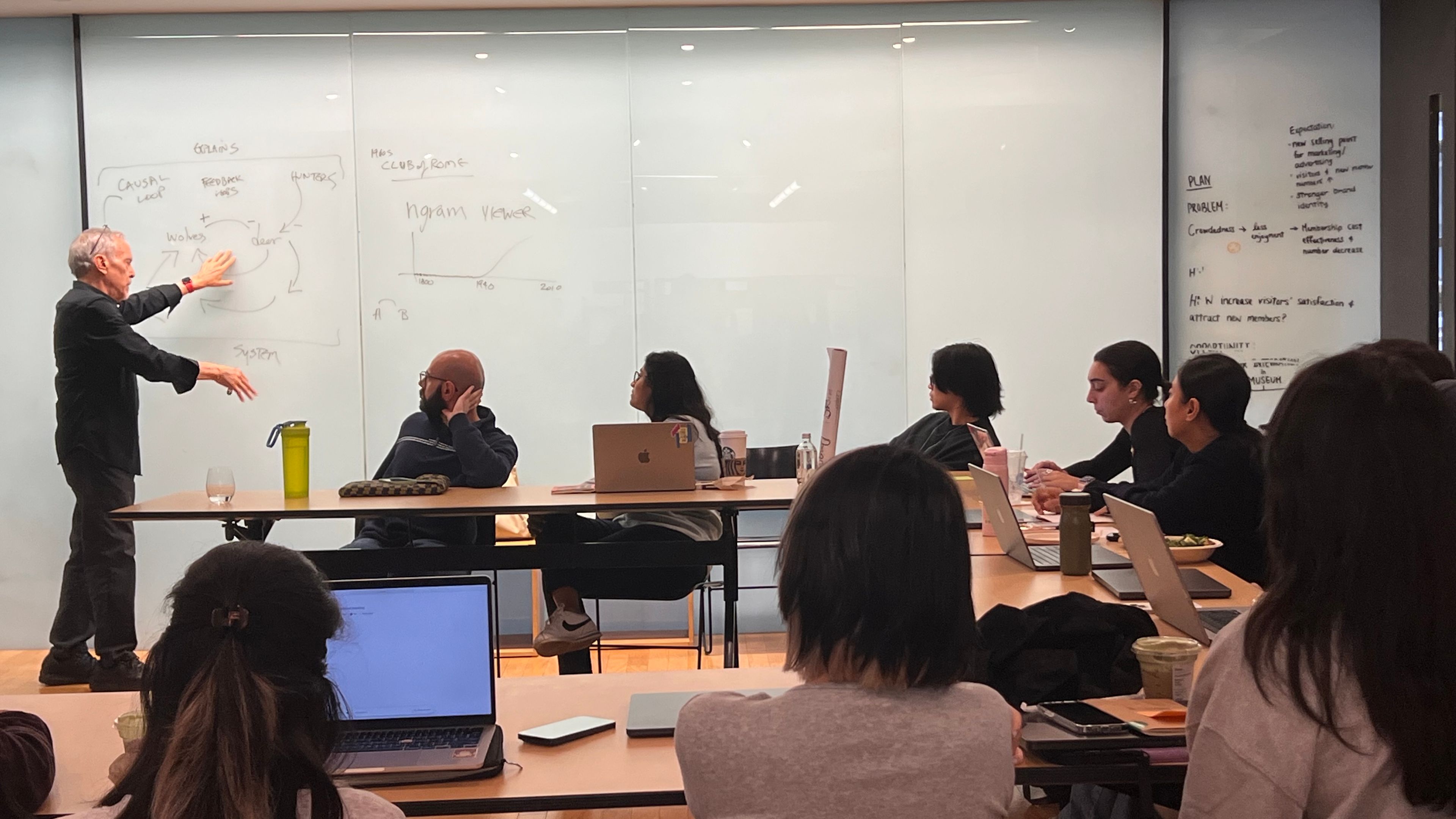
As the fall semester comes to an end and we move towards our final semester, there is a growing sense of grounded direction. We are not “done” figuring things out, but we have developed a stronger understanding of what matters, why it matters, and what questions are worth carrying forward. The work moves from identifying patterns to exploring how those patterns might be addressed through thoughtful interventions.
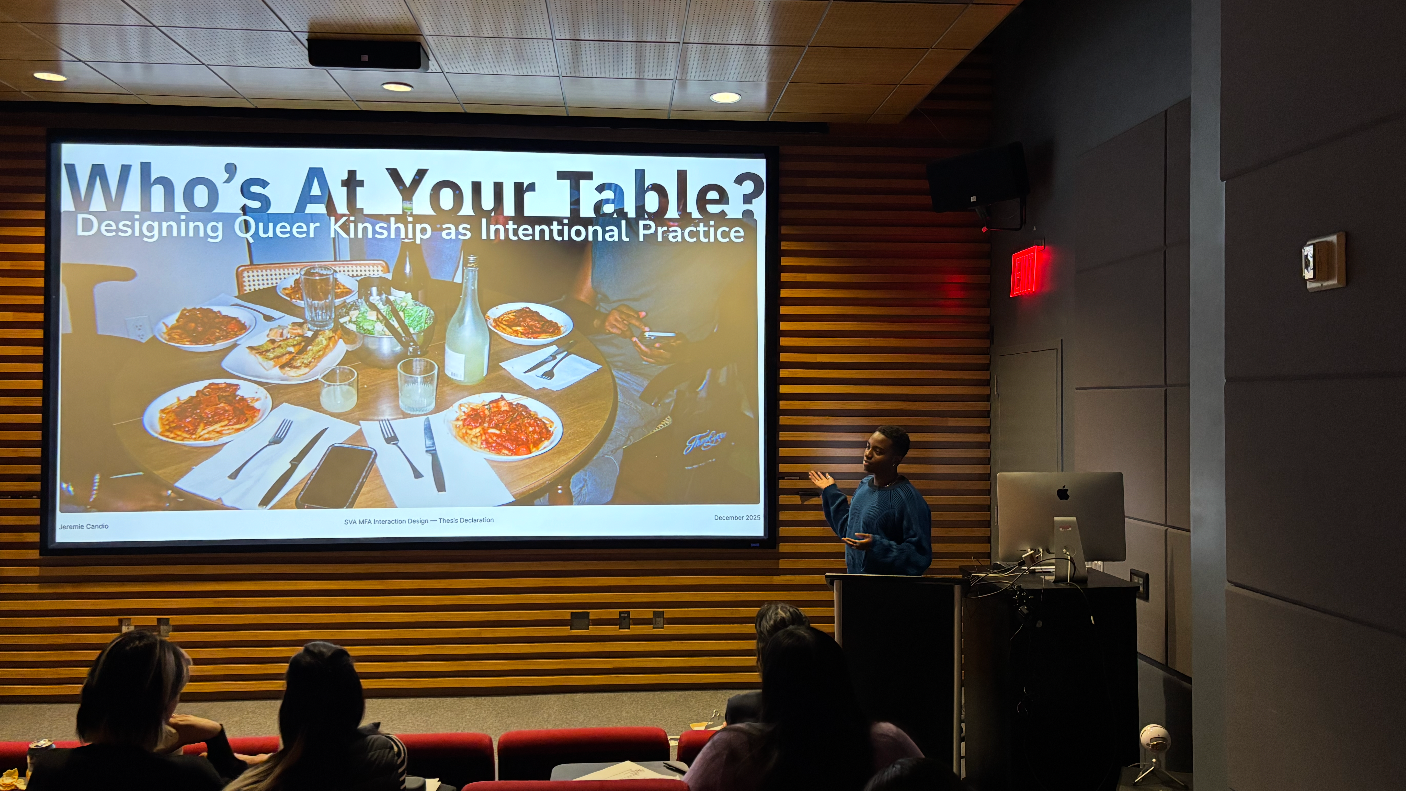
“Ambiguity became a sign—a guiding compass—that there was more that I had to uncover. Whether it was reading more scholarly articles, looking for more perspectives from SMEs, or talking with people, ambiguity became a doorway to curiosity.”
— Nicole Lucero-Huerta, ixD student
Perhaps the most enduring takeaway is this: ambiguity is not something designers must eliminate as quickly as possible, but something they must learn to work with in order to grow. Thesis is where we first encounter this lesson, but our understanding of it will continue to deepen and evolve throughout our lives as designers.